Strength training is one of the most effective ways to build a healthier body, yet most beginners feel intimidated the first time they walk past the weight rack. The good news is that you do not need a gym membership, heavy weights, or years of experience to get started. With a few foundational movements and a simple plan, anyone can begin building strength safely in 2026.

Why Strength Training Matters at Every Age
Strength training, also called resistance training, involves working your muscles against an external force — dumbbells, resistance bands, machines, or simply your own body weight. The benefits go far beyond bigger muscles. Regular resistance exercise increases bone density, improves balance and posture, speeds up metabolism, and helps regulate blood sugar. Research consistently shows that adults who lift weights two to three times per week have stronger bones, healthier joints, and a lower risk of age-related muscle loss known as sarcopenia. For women especially, strength training is one of the best defenses against osteoporosis. It also boosts mood: the sense of progress from lifting a little more each week builds confidence that carries into everyday life.
How Often Should Beginners Train?
When you are just starting out, less is more. Aim for two to three full-body sessions per week, with at least one rest day between workouts. Muscles grow during recovery, not during the workout itself, so rest days are part of the plan, not a break from it. Each session should last 30 to 45 minutes — long enough to be effective but short enough to stay consistent. A Monday, Wednesday, Friday schedule works well for many beginners, while others prefer Tuesday, Thursday, and Saturday. The exact days do not matter. What matters is sticking with the routine for at least six to eight weeks so your body can adapt and your technique can improve before you add intensity.
The 6 Foundational Moves Every Beginner Should Learn
Forget complicated routines. Almost every effective beginner program is built around a small set of compound movements that train multiple muscle groups at once. Master these six, and you have a complete workout:
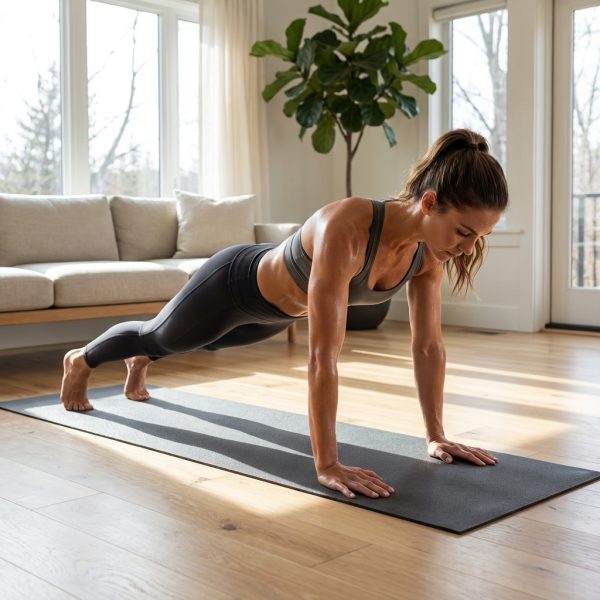
- Push-ups (or knee push-ups): Build chest, shoulder, and tricep strength. Start with your knees on the floor if a full push-up is too hard.
- Bodyweight squats: Strengthen the legs and glutes. Keep your chest up and push your knees outward as you lower down.
- Dumbbell rows: Target the back and biceps. Support one knee on a bench or chair and pull the weight toward your hip.
- Glute bridges: Activate the glutes and protect the lower back. Lie on your back, feet flat, and lift your hips toward the ceiling.
- Standing dumbbell press: Develop shoulder strength and stability. Start with light weights and keep your core tight.
- Planks: Build core stability. Hold a straight line from head to heels, beginning with 20 to 30 seconds.
Focus on perfect form before adding weight. A lighter weight lifted with control builds more strength over time than a heavy weight lifted with sloppy technique.
A Simple Beginner Workout Plan
Here is a straightforward full-body session you can repeat two to three times per week. Rest 60 to 90 seconds between sets, and 90 seconds to two minutes between exercises.
- Bodyweight squats — 3 sets of 10 to 12 reps
- Push-ups — 3 sets of 8 to 10 reps
- Dumbbell rows — 3 sets of 10 reps per side
- Glute bridges — 3 sets of 12 reps
- Standing dumbbell press — 3 sets of 8 reps
- Plank — 3 holds of 20 to 30 seconds
Progress gradually. When you can complete all sets and reps with good form, add a small amount of weight or a couple of extra reps. This principle, called progressive overload, is the engine of strength gains.
Common Mistakes Beginners Should Avoid
Most beginner injuries and frustrations come from a handful of avoidable errors. Watch out for these:
- Skipping the warm-up: Five minutes of light cardio and dynamic stretches prepare your muscles and joints for work.
- Lifting too heavy too soon: Start lighter than you think you can handle. Your joints and tendons adapt more slowly than your muscles.
- Holding your breath: Exhale on the effort and inhale on the return. Steady breathing protects your blood pressure.
- Training the same muscles every day: Muscles need 48 hours to recover. Hitting the same group daily stalls progress.
- Neglecting one side: Unilateral exercises like rows reveal strength imbalances. Train both sides equally.
- Expecting overnight results: Visible changes typically take eight to twelve weeks. Track your lifts in a notebook or app to see progress you cannot yet see in the mirror.
Nutrition and Recovery: The Other Half of the Equation
Your workouts are only half the story. Muscles need protein to rebuild — aim for roughly 0.7 to 1 gram of protein per pound of body weight per day, spread across meals. Lean meats, eggs, dairy, legumes, and tofu are all excellent sources. Stay hydrated, and do not fear carbohydrates: they fuel your training sessions. Sleep matters just as much as food. During deep sleep, your body releases growth hormone that repairs muscle tissue, so aim for seven to nine hours per night. Finally, listen to your body. Sharp pain, joint swelling, or pain that changes how you move are signals to rest and, if needed, see a professional. Normal muscle soreness peaks 24 to 48 hours after a workout and fades with consistent training.
Conclusion
Starting strength training in 2026 does not require a perfect plan or fancy equipment — it requires a simple routine, good form, and the patience to show up week after week. Begin with two or three short sessions, master the six foundational movements, and add weight gradually. Within a few months, you will be stronger, more energetic, and more confident than when you started. Pick a start date, grab a pair of dumbbells, and take the first step.